Guarantee safe & secure checkout
Alder (Alnus glutinosa) is a fast-growing, native Irish tree that thrives in damp or waterlogged soils, making it ideal for wetlands, riverbanks, and areas prone to flooding. With its distinctive rounded, glossy leaves and small cone-like fruits, Alder is both a practical and attractive choice for hedging, particularly in wetter environments. Known for its nitrogen-fixing ability, Alder improves soil fertility and supports a wide range of wildlife, making it an excellent addition to environmentally focused planting schemes.
Alder is a robust, low-maintenance tree but benefits from a few key practices to ensure healthy growth.
Planting: Alder grows best in moist, waterlogged, or poorly drained soils and can tolerate full sun or partial shade. It is often planted near rivers, ponds, or damp fields, but it can also tolerate drier conditions once established. Space plants about 1.5-2 meters apart when planting as part of a hedge or woodland scheme.
Pruning: While Alder requires little pruning, young trees can be shaped to encourage strong, straight growth. Any damaged or weak branches can be removed in late winter or early spring to improve the tree’s structure. If used as a hedge, occasional trimming helps maintain its shape and density.
Watering: Alder naturally thrives in wet areas, so additional watering is generally only necessary for young trees during their first growing season, or in particularly dry periods. Once established, they are very drought-tolerant.
Pest & Disease Resistance: Alder is generally resistant to most pests and diseases, though it can occasionally be affected by phytophthora root rot in particularly waterlogged soils. Ensuring proper planting conditions will reduce this risk.
Alder is a key species for ACRES Scheme projects, especially in areas where soil improvement, water management, or flood prevention are essential. Its ability to fix nitrogen, improve soil quality, and stabilize wetland areas makes it a valuable choice for farmers aiming to enhance the environmental value of their land while contributing to local biodiversity and soil health.
Fagus sylvatica
Also known as European beech trees, are deciduous trees that are native to Europe, Asia, and North Africa. They are known for their smooth, grey bark and their bright green, oval-shaped leaves. Green beech trees can grow to be quite tall, with some reaching up to 120 feet in height. They are also long-lived trees, with some specimens living for more than 300 years. Green beech trees are popular ornamental trees and are often planted in gardens and parks. They are also used in forestry and as shade trees. In the fall, the leaves of green beech trees turn golden brown before falling off the tree
Suitable for ACRES
Prunus laurocerasus 'Rotundifolia' - Round-leaved Cherry Laurel
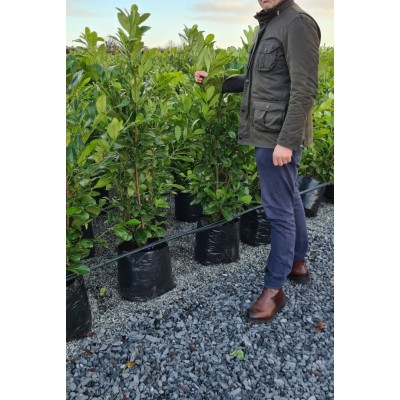
A compact variety of Cherry Laurel with distinctive rounded, glossy dark green leaves that create a dense, formal appearance. This cultivar offers a neater, more manageable alternative to the vigorous common Cherry Laurel, making it excellent for hedging and screening where space is limited.
Laurus nobilis P20 35-40cm Crown on 1/4 Stem
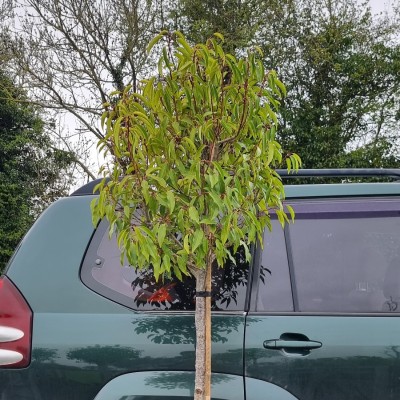
3/4 Standard Portuguese Laurel, a variant of Prunus lusitanica, is a versatile evergreen tree with a well-defined, rounded canopy that reaches three-fourths of its natural mature height. Recognized for its glossy, dark green leaves, this tree is prized for its adaptability to various soil types and its suitability for hedges, screens, or standalone ornamental use. Its dense foliage and year-round greenery contribute to an elegant and formal appearance in gardens or landscapes.
The Fagus sylvatica 'Atropurpurea,' commonly known as Copper Beech, is a majestic deciduous tree famed for its deep purple to copper-colored foliage that creates a stunning presence in the landscape. With a broad, rounded canopy and smooth gray bark, this tree grows up to 50-60 feet tall and 35-40 feet wide at maturity, making it ideal for large gardens or parkland settings. Its striking leaf color shifts to bronze tones in the fall, offering year-round interest and a sense of grandeur.
Bay hedges, or Laurus nobilis, are evergreen hedges with fragrant, dark green foliage that adds both beauty and practicality to any landscape. They can grow up to 20 feet tall, are low-maintenance, and can be easily pruned to maintain a desired height and shape. Bay hedges are popular for their culinary uses and can be used to create natural barriers for privacy, sound reduction, and wind protection, as well as for topiary designs.
Laurus nobilis, also known as sweet bay or bay laurel
Sold as Pot size 1/2 Std size of the ball is 30-40 cm
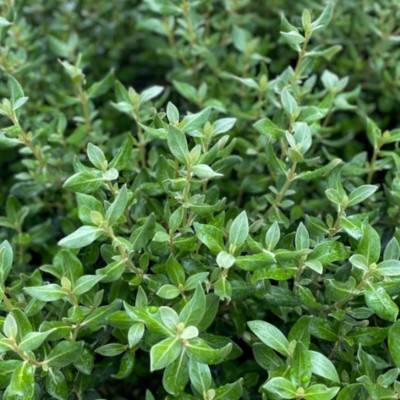
Olearia traversii can be an excellent choice for a hedge, particularly in coastal areas or locations with well-drained soils. Its dense growth habit, attractive silvery-gray foliage, and adaptability to coastal conditions make it a desirable option for landscaping purposes.