- Out-of-Stock


Guarantee safe & secure checkout
Blackthorn (Prunus spinosa) is a native Irish hedging plant known for its thorny branches, early spring flowers, and autumn fruit. This robust and hardy shrub is ideal for creating dense, natural hedgerows that provide year-round shelter for wildlife. In spring, Blackthorn produces a stunning display of white blossoms before its leaves emerge, followed by small, dark purple sloes in autumn, which are valued by both wildlife and humans.
Wildlife-Friendly: Blackthorn hedging provides excellent habitat for birds and small mammals. Its dense, thorny growth offers ideal nesting sites, while the sloes are a valuable food source for birds in autumn.
Seasonal Interest: Early spring blooms bring a burst of white flowers, while the sloes add autumn interest to your landscape.
Natural Barrier: The thick, spiny branches form a highly effective barrier for livestock, making it popular for farms and rural boundaries.
Native Species: As a native species, Blackthorn supports local ecosystems and plays a crucial role in maintaining biodiversity in Ireland.
Blackthorn is relatively low-maintenance but benefits from regular attention to ensure it thrives as a dense, healthy hedge.
Planting: Best planted in the autumn or early spring, Blackthorn thrives in well-drained soils and can tolerate both full sun and partial shade. Ensure proper spacing (around 30-40 cm between plants) to allow for thick, healthy growth.
Pruning: Light winter pruning helps shape the hedge and encourages denser growth. Cut back any weak or crossing branches to maintain its structure. If planting Blackthorn as a hedge, coppicing (cutting it back hard every few years) promotes strong regrowth.
Watering: Once established, Blackthorn is quite drought-resistant, but young plants should be watered regularly in their first year to help them settle and establish strong root systems.
Pest & Disease Resistance: Blackthorn is relatively pest-free but can occasionally be affected by black knot fungus. Regular inspection and removal of infected branches can help manage this.
Due to its value in promoting biodiversity and providing shelter, Blackthorn is a recommended choice for ACRES Scheme participants looking to enhance the environmental impact of their farms.
Tubex Nature™ Standard Tree Shelter is one of the most popular twin-walled tree shelters to protect growing trees from wildlife damage while supporting tree growth, designed for hard-to-reach areas where collection isn’t possible.
Please note:
Tubex Standard 75cm is suitable for new ACRES scheme
Bay hedges, or Laurus nobilis, are evergreen hedges with fragrant, dark green foliage that adds both beauty and practicality to any landscape. They can grow up to 20 feet tall, are low-maintenance, and can be easily pruned to maintain a desired height and shape. Bay hedges are popular for their culinary uses and can be used to create natural barriers for privacy, sound reduction, and wind protection, as well as for topiary designs.
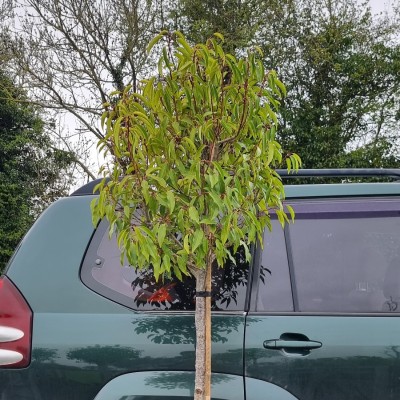
3/4 Standard Portuguese Laurel, a variant of Prunus lusitanica, is a versatile evergreen tree with a well-defined, rounded canopy that reaches three-fourths of its natural mature height. Recognized for its glossy, dark green leaves, this tree is prized for its adaptability to various soil types and its suitability for hedges, screens, or standalone ornamental use. Its dense foliage and year-round greenery contribute to an elegant and formal appearance in gardens or landscapes.
Fagus sylvatica
Also known as European beech trees, are deciduous trees that are native to Europe, Asia, and North Africa. They are known for their smooth, grey bark and their bright green, oval-shaped leaves. Green beech trees can grow to be quite tall, with some reaching up to 120 feet in height. They are also long-lived trees, with some specimens living for more than 300 years. Green beech trees are popular ornamental trees and are often planted in gardens and parks. They are also used in forestry and as shade trees. In the fall, the leaves of green beech trees turn golden brown before falling off the tree
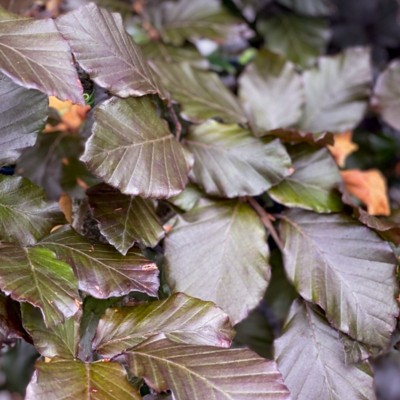
The Fagus sylvatica 'Atropurpurea,' commonly known as Copper Beech, is a majestic deciduous tree famed for its deep purple to copper-colored foliage that creates a stunning presence in the landscape. With a broad, rounded canopy and smooth gray bark, this tree grows up to 50-60 feet tall and 35-40 feet wide at maturity, making it ideal for large gardens or parkland settings. Its striking leaf color shifts to bronze tones in the fall, offering year-round interest and a sense of grandeur.
The Fagus sylvatica 'Atropurpurea,' commonly known as Copper Beech, is a majestic deciduous tree famed for its deep purple to copper-colored foliage that creates a stunning presence in the landscape. With a broad, rounded canopy and smooth gray bark, this tree grows up to 50-60 feet tall and 35-40 feet wide at maturity, making it ideal for large gardens or parkland settings. Its striking leaf color shifts to bronze tones in the fall, offering year-round interest and a sense of grandeur.
Suitable for ACRES
Laurus nobilis P20 35-40cm Crown on 1/4 Stem
Euonymus 'Aureomarginatus' is a species of evergreen shrub that is known for its variegated foliage. It is also commonly known as golden margin Euonymus or golden edge Euonymus. The shrub typically grows to a height and width of around 6-8 feet and has a dense and bushy growth habit.
Sold as 9 Litre 1/4 Std
Betula pendula also known as Silver birch